If you’ve done any research on non-surgical options for chronic pain, tendon injuries, or stubborn soft tissue problems, you’ve probably come across shockwave therapy. It shows up in conversations about plantar fasciitis, rotator cuff issues, tennis elbow, and a handful of other conditions that tend to respond poorly to rest alone and keep coming back after conventional treatment.
What you may not have come across yet is PiezoWave, which is related to shockwave therapy but different enough that treating them as interchangeable misses something important. The distinction matters if you’re trying to figure out whether this kind of therapy makes sense for what you’re dealing with and what to expect from it.
This blog exists to give you a clear, honest picture of both, what shockwave therapy is, how PiezoWave differs, what conditions it addresses, what the experience actually feels like, and what’s available at Howell Chiropractic in Davenport for patients across the Quad Cities.
What Shockwave Therapy Actually Is
Shockwave therapy, in its original form, was developed in the 1980s as a non-surgical method for breaking up kidney stones. Researchers noticed that the acoustic energy used in that process also had significant effects on soft tissue, and over the following decades the technology was adapted for musculoskeletal applications.
The basic principle is straightforward. High-energy acoustic pressure waves are delivered to a targeted area of tissue. These waves create a mechanical force at the cellular level that triggers a cascade of biological responses: increased blood flow to the area, stimulation of collagen production, breakdown of calcifications, disruption of pain signal transmission, and activation of the body’s natural healing processes.
The result, across a significant body of research, is that shockwave therapy accelerates healing in tissues that have become chronically injured and stuck in a non-healing cycle. This is particularly relevant for tendons, which have notoriously poor blood supply and often develop the kind of chronic degenerative changes that the body struggles to heal on its own.
Traditional shockwave therapy tends to be high-energy and can be uncomfortable during treatment. The original devices used radial (pressure wave) technology that delivers energy broadly across an area, or focused technology that concentrates energy at a specific depth. Both have clinical applications and both are effective for the conditions they’re designed to treat.
Where PiezoWave Fits In
PiezoWave is a specific type of focused shockwave therapy that uses piezoelectric technology to generate and deliver acoustic pressure waves. The distinction from traditional radial shockwave devices comes down to precision, depth of penetration, and the character of the wave itself.
Piezoelectric technology generates waves through the mechanical deformation of piezoelectric crystals, which produces a wave with a very specific shape and energy profile. The result is a focused wave that can be precisely targeted to a specific depth in the tissue, delivering its energy exactly where it’s needed rather than broadly across a treatment area.
This precision matters for a few reasons. It allows the provider to target deep tissue structures, like tendons, joint capsules, and fascial layers, without the same level of surface discomfort that higher-energy radial devices can produce. It also allows for more precise treatment of smaller, more specific areas, which is particularly relevant for conditions like TMJ dysfunction, plantar fasciitis at a specific insertion point, or a localized trigger point in a muscle belly.
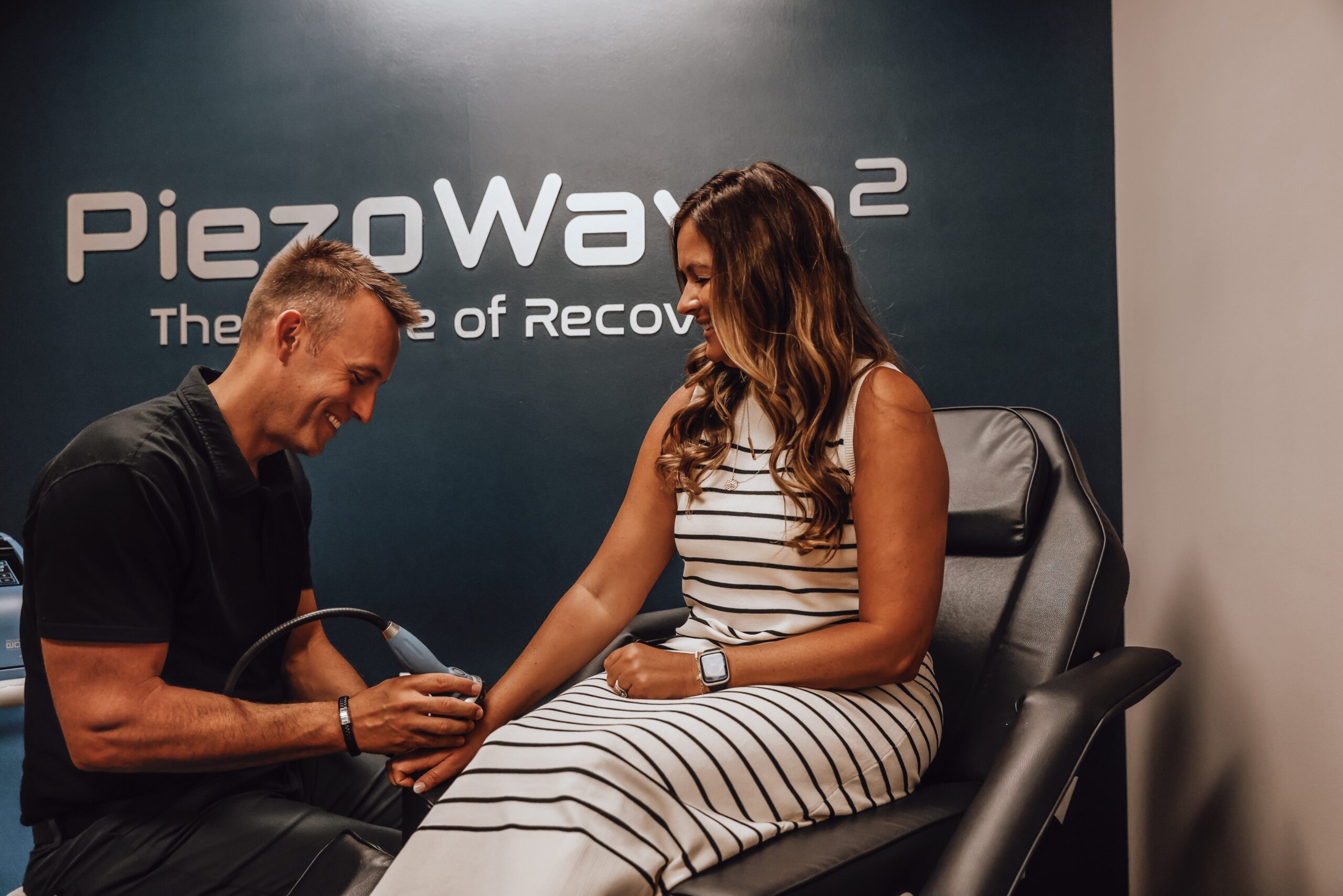
The PiezoWave device at Howell Chiropractic also offers the ability to switch between focused wave delivery for deep tissue work and radial wave delivery for broader surface treatment within the same session, which provides flexibility that a single-mode device doesn’t.
Insider Tip from Dr. Travis: “PiezoWave fills a gap that chiropractic adjustments alone don’t always reach. The nervous system work we do with adjustments addresses the neurological and structural picture, but there are conditions involving chronic tendon degeneration, deep fascial restriction, or calcification that need a different kind of input to heal. PiezoWave gives us that tool, and the combination of the two approaches produces results that neither produces as reliably on its own.”
What Conditions PiezoWave Addresses
PiezoWave therapy at Howell Chiropractic is used for a specific range of conditions where chronic tissue degeneration, tendinopathy, fascial restriction, or calcification is the primary driver of the problem.
Tendinopathies are the most common application. Tendons that have developed chronic degenerative changes, the kind that show up as tendinosis rather than acute tendinitis, respond particularly well to focused acoustic wave therapy. The acoustic energy stimulates the cellular repair processes that have stalled in chronically degenerated tendon tissue, essentially restarting a healing response that the body had given up on.
Common tendinopathies treated with PiezoWave include:
- Rotator cuff tendinopathy, particularly supraspinatus involvement, which is one of the most common sources of shoulder pain in active adults
- Lateral epicondylitis (tennis elbow) and medial epicondylitis (golfer’s elbow), both of which involve chronic degeneration at the tendon insertions on the elbow
- Patellar tendinopathy (jumper’s knee), common in athletes who do a lot of jumping and landing
- Achilles tendinopathy, which can be remarkably resistant to conventional treatment and often responds well to focused acoustic wave therapy
- Plantar fasciitis, particularly chronic cases where the initial inflammatory phase has resolved but the fascial tissue remains thickened and painful
- Hip flexor and gluteal tendinopathies that affect runners, cyclists, and active adults
Calcific tendinitis is another strong application for PiezoWave. When calcium deposits form within a tendon, usually the rotator cuff, the acoustic waves can help break up the calcification and facilitate its reabsorption by the body. This is a condition where focused shockwave therapy has some of the strongest research support in the literature.
Myofascial trigger points respond well to the focused wave delivery that PiezoWave provides. Trigger points, the dense nodules of contracted muscle fiber that refer pain to other areas of the body, can be targeted with precision using the piezoelectric focused wave, producing a release that’s often faster and more complete than manual trigger point work alone.
TMJ dysfunction and jaw pain is a condition that benefits from PiezoWave in ways that fewer providers are using it for. The muscles and fascial structures around the temporomandibular joint frequently develop the kind of chronic tension and myofascial restriction that responds well to focused acoustic wave therapy, and the precision of PiezoWave’s delivery makes it well suited to this relatively small and complex anatomical area.
Shoulder impingement and bursitis often involve a combination of tendon degeneration and inflammatory changes in the bursa that PiezoWave can address simultaneously, making it a useful tool for the complex shoulder presentations that don’t fit neatly into a single diagnostic category.
How It Feels During Treatment
One of the questions patients ask most often before their first PiezoWave session is what it actually feels like. The honest answer is that it varies depending on the area being treated, the depth of penetration being used, and the individual patient’s tissue sensitivity.
For most patients, PiezoWave therapy produces a sensation that ranges from a dull pressure to a mild tapping or percussion feeling at the treatment site. When the device is working on a particularly irritated or degenerated area of tissue, it can produce a sharp or aching sensation that most patients describe as a productive discomfort rather than true pain. This discomfort typically fades quickly as the treatment progresses and the tissue responds to the acoustic input.
The focused wave technology of PiezoWave is generally more comfortable than higher-energy radial shockwave devices,particularly for sensitive areas or patients who have had uncomfortable experiences with other shockwave devices in the past. This is one of the reasons providers who work with a range of patient populations, including older adults and patients with heightened pain sensitivity, often prefer PiezoWave.
Sessions typically last between fifteen and thirty minutes depending on the number of areas being treated and the specific protocol being used. Most patients notice some immediate change in tissue feel or pain level following treatment, with more significant changes accumulating over the course of the treatment series.
How Many Sessions Does It Take?
This depends significantly on the condition being treated, how long it’s been present, and how the individual patient responds. Dr. Travis develops a specific recommendation based on the patient’s case, but there are general patterns worth understanding.
For acute to subacute presentations where the tissue hasn’t been in a chronic non-healing state for long, meaningful improvement often occurs within two to four sessions. The body’s repair processes are still relatively active and respond quickly to the additional stimulus that PiezoWave provides.
For chronic presentations where the tissue has been stuck in a degenerative cycle for months or years, a longer course of treatment is typically needed. Most chronic tendinopathies require six to twelve sessions for significant and lasting improvement, with sessions typically spaced one week apart to allow the tissue to complete the healing response stimulated by each treatment before the next session adds to it.
Calcific tendinitis often requires a slightly longer course of treatment as the calcification breaks down gradually over multiple sessions.
For conditions at Howell Chiropractic, PiezoWave is priced at $100 per region per session, and Dr. Travis provides a clear recommendation at the initial evaluation so patients understand what the full course of treatment involves before they begin.
Did You Know? A systematic review published in the British Journal of Sports Medicine found that extracorporeal shockwave therapy, of which PiezoWave focused wave therapy is a type, produced significant improvements in pain and function for chronic tendinopathies across multiple body regions, with the strongest evidence for plantar fasciitis, lateral epicondylitis, and calcific rotator cuff tendinitis. The review concluded that shockwave therapy should be considered a first-line treatment option for these conditions before surgical intervention is considered.
PiezoWave as Part of a Comprehensive Care Plan
At Howell Chiropractic, PiezoWave therapy rarely stands alone. It’s most effective as part of a care plan that addresses the full picture of what’s driving the patient’s condition, which almost always includes a nervous system and structural component alongside the tissue degeneration that PiezoWave addresses directly.
For a patient with chronic shoulder pain, for example, the rotator cuff tendinopathy that PiezoWave targets is often accompanied by cervical and thoracic spine restrictions that are affecting how the shoulder moves and how the nervous system is signaling to the surrounding musculature. Addressing the tendon degeneration with PiezoWave while simultaneously addressing the spinal restrictions with chiropractic adjustments produces more complete and more lasting results than either approach alone.
It’s also worth noting that PiezoWave fits naturally into the care of patients who are already receiving chiropractic adjustments for an unrelated primary complaint and have a secondary soft tissue issue that hasn’t been addressed. A parent who comes in for nervous system based family care and mentions their chronic Achilles problem in passing doesn’t need to start a separate relationship with a separate provider. The conversation about whether PiezoWave makes sense for that Achilles can happen in the same office, with a provider who already understands their full health picture.
This integrated approach is one of the things that makes the Howell Chiropractic experience different from a standalone shockwave therapy clinic. The tissue is being treated and the system driving the tissue’s behavior is being addressed simultaneously.
Is PiezoWave Right for You?
PiezoWave therapy is worth considering if you’re dealing with a tendon problem, a fascial restriction, or a soft tissue condition that hasn’t responded fully to rest, physical therapy, anti-inflammatory medication, or conventional chiropractic care alone.
It’s particularly worth exploring if you’ve been told that surgery might be the next step for a tendinopathy or calcific tendinitis. Focused shockwave therapy has a strong evidence base as an alternative to surgical intervention for these conditions, and the risk profile is significantly more favorable than any surgical option.
The process at Howell Chiropractic starts with a complimentary virtual consultation where Dr. Travis can review your history, your imaging if you have it, and your current symptoms to give you an honest picture of whether PiezoWave makes sense for your situation and what a realistic course of treatment would look like.
If you’ve been managing the same soft tissue problem for months without real resolution, this is a conversation worth having. Book at howelldc.com or reach out by call or text anytime.
Howell Chiropractic serves patients across the Quad Cities including Davenport, Bettendorf, Moline, and Rock Island. Dr. Travis Howell offers PiezoWave therapy alongside nervous system based chiropractic care for a comprehensive approach to musculoskeletal and soft tissue conditions. To schedule your complimentary virtual consultation, visit howelldc.com.